
· by Michael Blair, Nashville's Deck
A stack of pressure treated lumber at the yard all looks alike, green or brown and stamped with a staple-on tag at one end. The tag is the part that matters. Treated wood is sorted into use categories by the American Wood Protection Association, and the two you meet on a deck are UC3B, made for wood above the ground, and UC4A, made for wood in contact with it. Which one each piece of a deck should be is not as obvious as the names suggest, because some parts that never touch the soil are still expected to carry the ground contact rating.
Is all pressure treated wood ground contact?
No, pressure treated wood is not all rated for ground contact, and the rating is written on each piece rather than shown by its color. The AWPA U1 standard excerpt defines UC3B as exterior wood kept off the ground, the category for decking, railings, walkways and fence pickets. UC4A is the general ground contact category, for wood in contact with soil or fresh water and for wood that sits above the ground in conditions the standard treats as being just as hard on it.
The USDA Forest Service summary of the AWPA use categories lays the same ladder out in a table: UC3B for aboveground exterior work that is uncoated or sheds water poorly, UC4A for ground contact, and UC4B above that for parts that are critical or difficult to replace. A board treated for the higher category works in the lower one. The reverse is the mistake: an above-ground board set in the dirt is outside what it was treated for.
Which parts of a deck need ground contact lumber?
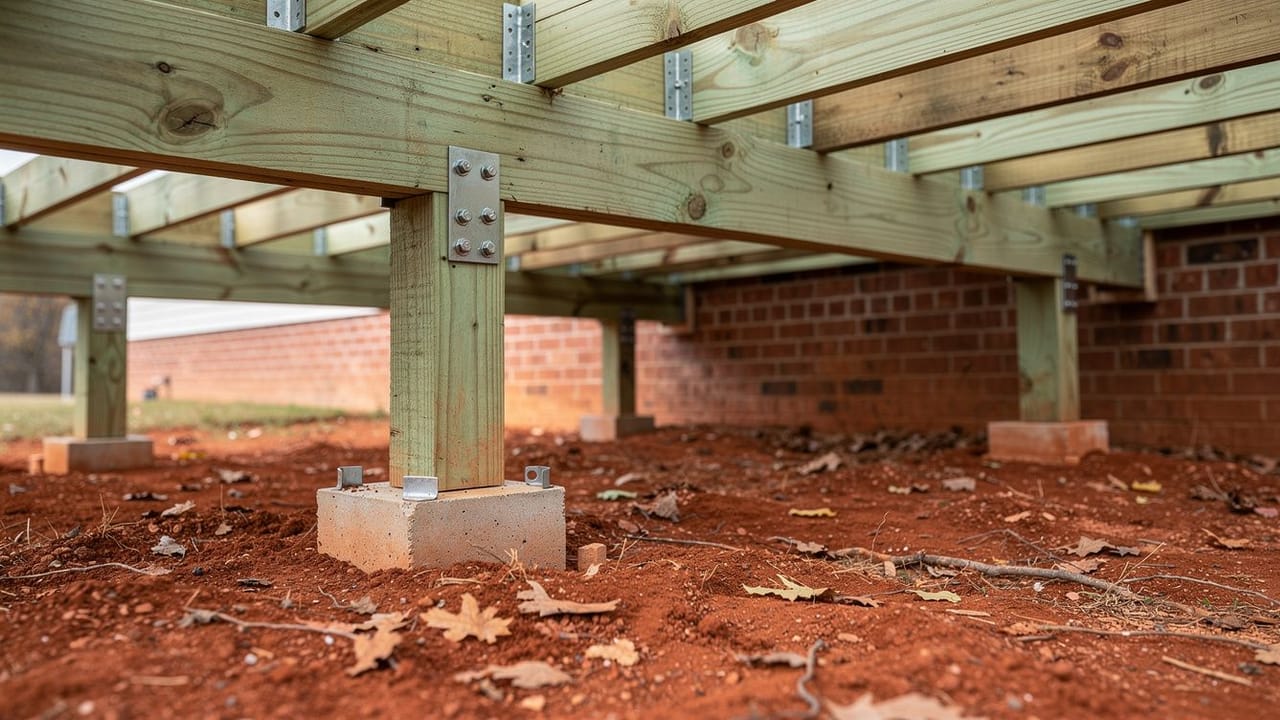
Posts, the ledger and any stair parts that touch the ground need ground contact lumber, and the boards you walk on generally do not. The AWPA residential infographic on choosing preserved wood draws a deck and labels each part. Posts and the ledger are marked Use Category 4A or higher. Stairs are 3B above the ground and 4A where they meet it. Deck boards, railings and the joists and beams are marked 3B or higher, each with a footnote.
The footnote is where the framing changes category. It says parts that are physically above the ground may still need ground contact treatment when they are joists and beams that are difficult to replace and critical to the structure, or when climate, construction or natural processes expose them to the same hazards as wood in the soil. AWPA closes the sheet by asking builders to decide case by case from the actual site. On the new decks we build, that decision is made per part, not per order.
Do deck joists need to be ground contact rated?
Deck joists and beams need the ground contact rating whenever they are critical to the deck and hard to get at for repair. The U1 excerpt says so in a note: joists and beams shall be treated to UC4A when they are difficult to maintain, repair or replace and critical to the safety of the whole structure. The Forest Service table, an older summary, still lists deck joists under UC3B, so the two sources do not line up. We follow the current standard’s note.
The same excerpt lists conditions that call for UC4A on wood above the ground. Among them: soil, leaf litter or other debris likely to build up against the wood; construction that will not let air move under the deck and between the boards; wood less than six inches above final grade resting on concrete or treated wood with no moisture break; and wood wetted again and again, as by a sprinkler that cannot be aimed away.
A low deck in a Middle Tennessee yard can meet several of those at once. Clay holds water against whatever sits on it, fall leaves collect under a deck that sits close to the ground, and humid summers dry the wood slowly. Our post on the part of a deck that actually fails covers what that dampness does to framing over time.
How do I know if treated lumber is rated for ground contact?
Read the end tag or the treatment stamp on the board; it states the use category, and that is the only reliable way to know. The AWPA infographic shows a sample tag and what each line means: the standard it was treated to (AWPA U1), the use category (UC3B on the sample), the preservative, the retention in pounds per cubic foot (.06 pcf on the sample), the exposure in words such as Above Ground, the inspection agency’s mark and the treating company’s name and town.
A board’s color says nothing about its category, so we check tags when the lumber is delivered and set aside anything marked for above-ground use that was meant for a post, a ledger or the framing. If you are replacing rotten framing on an existing deck, the tags on what is left may be long gone, which is one reason our deck repair work starts by finding out what the frame is made of. We build and repair decks across Nashville and Davidson County and the surrounding towns. To have the lumber on your deck looked at, or a new one planned with the right rating in each part, ask us for a free estimate.
Sources
- American Wood Protection Association, Select the Right Preserved Wood for Your Project (residential infographic, 2021) — Deck posts, ledger and stairs in ground contact: Use Category 4A or higher; deck boards, railing, joists and beams above ground: 3B or higher, with a footnote that critical, hard-to-replace joists and beams or parts exposed to ground contact hazards may need ground contact treatment; how to read the end tag.
- American Wood Protection Association, Standard U1-25 excerpt (use category definitions) — UC3B and UC4A definitions; joists and beams treated to UC4A when difficult to maintain, repair or replace and critical to the structure; the above-ground conditions that call for UC4A, including debris buildup, no air circulation, less than six inches above final grade without a moisture break, and frequent wetting.
- USDA Forest Service, Preservative-Treated Wood and Alternative Products in the Forest Service, Table 3 — Summary of AWPA use categories prepared by AWPA: UC3B for aboveground exterior construction, UC4A for ground contact, UC4B for critical or hard-to-replace components; lists deck joists under UC3B.
FAQ
Ground Contact Treated Lumber: Which Deck Parts Need It — questions
What is ground contact pressure treated wood?
It is lumber treated to AWPA’s UC4A category, made for wood in contact with soil or fresh water and for wood above the ground that faces similar conditions. The rating is printed on the end tag or treatment stamp. Above-ground lumber, UC3B, is treated for exterior wood that stays off the ground.
Can you use above-ground treated lumber for deck posts?
Not according to the AWPA residential guide, which marks deck posts as Use Category 4A or higher. Above-ground lumber, UC3B, is treated for decking, railings and other exterior wood kept off the soil. A post is in the ground or on a footing at grade, so it needs the ground contact category.
What does UC4A mean on a lumber tag?
UC4A is the AWPA use category for general ground contact. On the tag it appears beside the standard, AWPA U1, along with the preservative and the retention in pounds per cubic foot. A tag reading UC3B means above-ground use only. UC4B is a heavier category for critical or hard-to-replace parts.
Should deck ledger boards be ground contact lumber?
Yes. The AWPA residential guide marks the ledger as Use Category 4A or higher. The ledger carries one side of the deck against the house, it is hard to replace, and the joists hang from it, so it falls under the standard’s note on critical framing that is difficult to repair.
Can you use ground contact lumber above ground?
Yes. A higher use category covers the lower ones, so UC4A lumber can be used anywhere UC3B is called for. On a deck that often means ordering the framing as UC4A even where it is above the ground, which the AWPA U1 note asks for on critical joists and beams.