
· by Michael Blair, Nashville's Deck
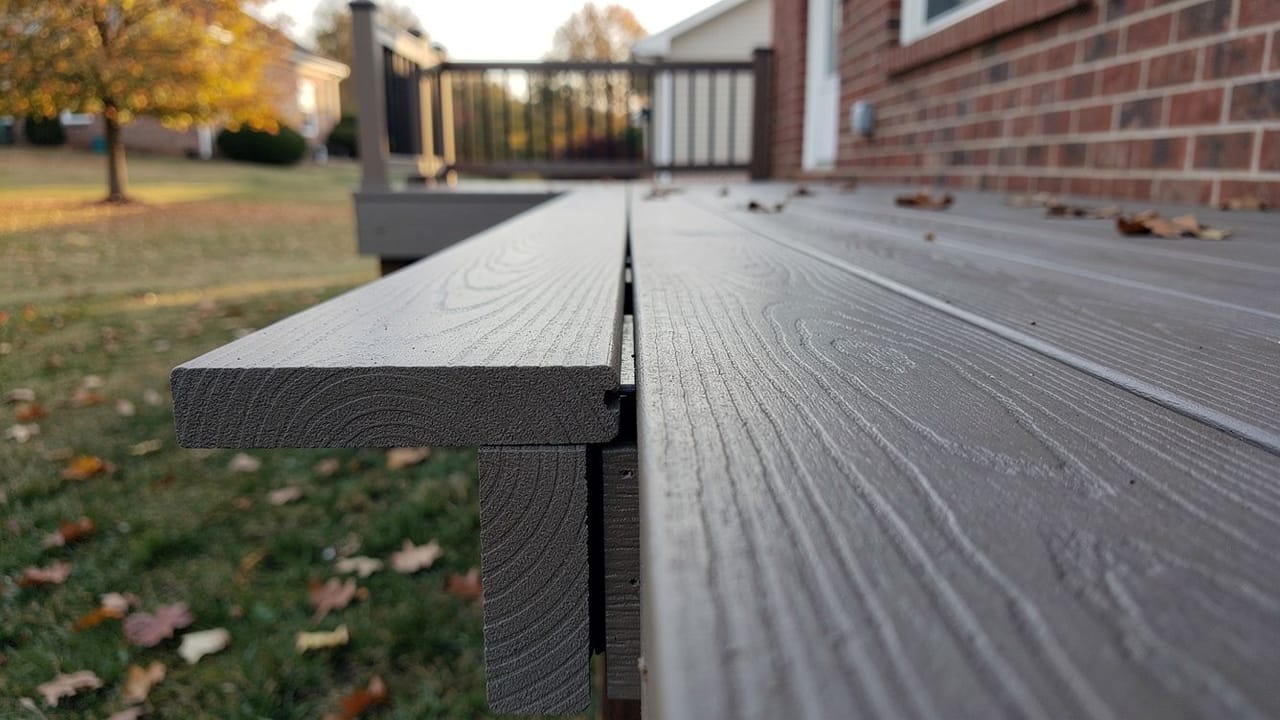
A composite deck has seams wherever a board is too short to run the full width, and at each one two boards meet end to end over the framing. That joint is where owners notice gaps opening in the cold months, and it is the one spot where the right spacing changes with the weather on the day the deck is built. The board makers publish charts for it, and they do not agree with each other. This is what the charts say, why the temperature matters, and how we handle it on the composite decks we build.
The butt joint gap, by brand
Each maker sets the end gap by the temperature at installation, and the two charts we read most often draw their lines in different places. The TimberTech composite installation guide asks for 3/16 inch at butt joints at 32°F and below, 1/8 inch from 33°F to 74°F, and 1/32 inch at 75°F and above. The 2026 Trex decking installation guide splits at 40°F instead: 1/8 inch end to end above it, 3/16 inch below it.
So a board fastened on a 60-degree morning gets 1/8 inch under either chart, while a board fastened on a hot afternoon gets 1/32 inch under TimberTech’s and still 1/8 inch under Trex’s. Neither is wrong; they are different boards. The chart for the product on the deck is the one that applies, and on a mixed order we work from each maker’s own figures.
The seam needs support under it as well as a gap. TimberTech’s guide says joists at butt joints must be doubled, so each board end has its own framing to fasten to.
Why does the temperature on installation day matter?
Because a composite board is longer when it is warm, and the gap you set is the gap at that length. TimberTech’s guide says its boards will expand, contract, move and gap as the temperature changes, and that the change in length is most significant during installation. A board fastened in summer heat is near its longest, so it needs only a sliver at the end. A board fastened on a freezing morning is near its shortest and needs more room to grow into.
The guide gives an example of how this goes wrong: boards cut on a hot afternoon and left outside overnight will have shrunk by the next morning, so the cut that fit yesterday falls short. Its advice is to fasten boards as soon after cutting as possible, and our crews cut and fasten in the same session for that reason. TimberTech also calls for extra framing, joists 6 to 8 inches apart at most, and top-down fastening only where a deck sits near glass or in heat reflected from it.
Middle Tennessee installs run across all of these lines. A deck built here can go down on a summer afternoon above TimberTech’s 75-degree mark or on a winter morning below Trex’s 40-degree mark, so we check the temperature and the chart when the boards go down, not when the deck was priced.
Why do my composite boards have wide gaps in winter?
Usually because the boards were fastened warm and are now cold. A gap set on a hot day leaves room for the board at its longest; in January the same board is shorter, and the difference shows at the ends. That movement is what the charts plan for. Trex’s guide adds that the gaps also leave room for the wood joists underneath to shrink.
A gap that opens past what the chart allows is a different matter. Trex says no gap should ever exceed 1/2 inch. Board ends that pull well beyond the maker’s figures, or that move more on one part of the deck than another, point us to the fastening and the frame: loose screws, a joist that has twisted, or a seam without doubled framing. Our post on composite joist spacing and blocking covers how a frame that moves pulls the gaps open unevenly.
Where the deck meets the house, and the side gaps
The boards also need room where they stop against a wall or a post. TimberTech asks for at least 3/16 inch where its boards meet an adjoining structure or post. Trex sets the gap against an abutting wall at 1/4 inch above 40°F and 1/2 inch below it, by the temperature at installation, and gives a minimum of 3/16 inch between boards side to side.
Side gaps are their own figure, and makers revise them and vary them by product line. The guide we cited in our joist spacing post gave 1/8 to 1/4 inch; the current TimberTech composite guide gives 1/8 inch at the least and 3/16 inch at the most. We gap to whatever the guide for the exact board in the order says on the day it goes down.
If you are weighing materials, our comparison of composite and wood decking covers the boards themselves. We build new decks across Nashville and Davidson County and the towns around it, including Forest Hills, Belle Meade, West Meade and Oak Hill. If gaps on your deck look wrong, or you are planning a new one, ask us for a free estimate.
Sources
- TimberTech Composite Installation Guide (TimberTech/AZEK, PDF) — Butt joint gaps of 3/16 in at 32°F and below, 1/8 in at 33–74°F, 1/32 in at 75°F and above; 3/16 in minimum at an adjoining structure or post; side-to-side 1/8 in minimum to 3/16 in maximum; doubled joists at butt joints; fasten soon after cutting; 6 to 8 in joists and top-down fastening near glass or high heat.
- 2026 Trex Decking Installation Guide, p. 24, Gapping and Overhang — End-to-end gap 1/8 in above 40°F and 3/16 in below, by temperature at installation; abutting gap 1/4 in above 40°F and 1/2 in below; width-to-width minimum 3/16 in in hot and cold weather; no gap over 1/2 in; gapping for drainage, thermal movement and joist shrinkage.
FAQ
Composite Deck End Gaps and Install-Day Temperature — questions
Should composite decking be gapped end to end?
Yes. Both TimberTech and Trex call for a gap where two boards meet end to end, sized by the temperature at installation. Trex says the gaps also help drainage and allow for the wood joists shrinking. Without one, a board fastened cold has no room to grow when the deck warms up.
What gap do composite deck boards need at a butt joint?
It depends on the brand and the day. TimberTech’s guide gives 1/32 inch at 75°F and above, 1/8 inch from 33°F to 74°F and 3/16 inch at 32°F and below. Trex’s 2026 guide gives 1/8 inch above 40°F and 3/16 inch below 40°F. Follow the chart for the board you have.
Can you install composite decking in cold weather?
Both makers’ guides publish cold-weather gaps rather than ruling it out. TimberTech asks for 3/16 inch at butt joints at 32°F and below, and Trex asks for 3/16 inch end to end and 1/2 inch against a wall below 40°F. The extra room is for the board to grow as it warms.
Does the installation temperature change the gap for composite boards?
Yes, for the ends and for the gaps against walls. A board is longer when warm, so it gets a smaller end gap on a hot day and a bigger one on a cold day. Trex keeps its 3/16 inch side-to-side minimum the same in hot and cold weather.
How big should the gap be where composite decking meets the house?
TimberTech asks for at least 3/16 inch where its boards meet an adjoining structure or post. Trex asks for 1/4 inch against an abutting wall when the boards go down above 40°F and 1/2 inch below 40°F. The house does not move with the boards, so they need room there.