
· by Michael Blair, Nashville's Deck
A deck railing is a guard, in code language, and a guard has three jobs: to be there when the drop is high enough to hurt, to be tall enough that an adult does not go over it, and to be tight enough that a small child does not go through it. Each of those has a number attached, and Metro Codes will check all three at the final inspection.
When a railing is required at all
The residential code requires a guard on any walking surface more than thirty inches above the ground below, measured at any point within a few feet of the edge. That measurement is taken to the grade below, not to the top of a planting bed, and on a sloped Middle Tennessee lot a deck can be low at the house and well over thirty inches at the far corner.
Below that height a railing is optional, and a low deck without one has a cleaner look. Many owners add one anyway for a sense of enclosure, and once it is there it is expected to meet the same rules as a required one.
Height and the opening rule
Residential guards must be at least thirty-six inches tall, measured from the deck surface to the top of the rail. Some jurisdictions and all commercial settings require forty-two inches. Anything less than thirty-six fails, and a railing built at thirty-four because the lumber came that way is a common reason a deck fails final.
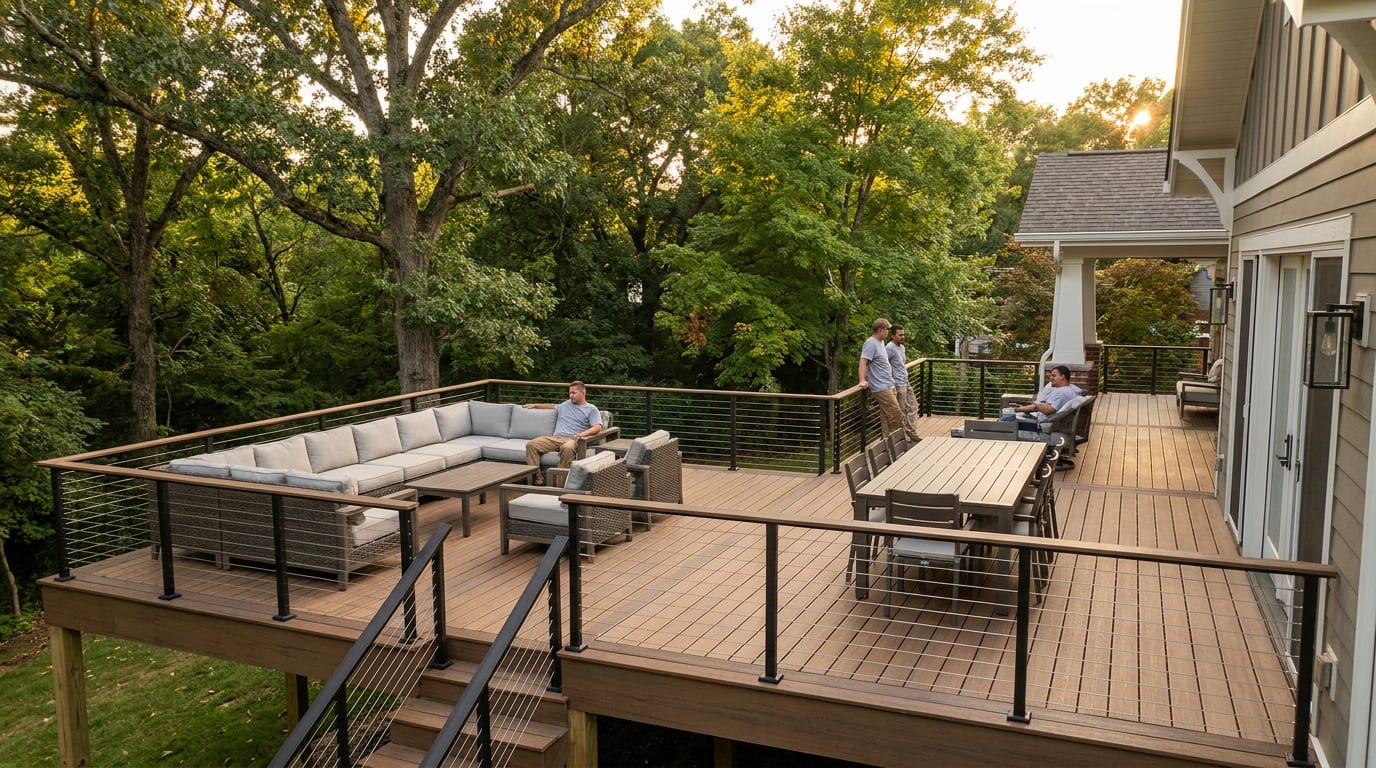
Openings in the railing, between balusters, between the bottom rail and the deck, anywhere, must not allow a four-inch sphere to pass. That is the rule that catches spacing done by eye. Balusters set at four inches on center with inch-and-a-half stock leave a two-and-a-half-inch gap, which is fine; set at five on center they leave three and a half, also fine; at six they fail. Cable rail and horizontal designs have to meet the same rule and cable that sags under a hand can fail it.
- Guard required where the drop exceeds thirty inches
- Minimum height thirty-six inches from deck surface to top of rail
- No opening that passes a four-inch sphere
- Stair guards have their own, slightly different, rules
Strength is the part nobody measures
The code requires a guard to resist a concentrated load applied at the top rail, and that is the requirement that decides how posts are attached. A post notched around the rim joist and held with two lag screws does not meet it. Posts through-bolted to the rim with the rim itself blocked back to the joists, or attached with the tension-tie hardware sold for the purpose, do.
A railing that moves when leaned on is a failed railing regardless of its height. This is also where older decks are most dangerous, because the post connection is the first thing rot reaches, and the railing looks fine until someone puts weight on it.
Stairs and the handrail
Stairs with more than a few risers need a graspable handrail on at least one side, between thirty-four and thirty-eight inches above the nosing of the treads. A graspable handrail is one a hand can close around, which a flat two-by-six cap rail is not. Where the stair is open on the side, a guard is needed there too, and the four-inch rule applies with a slightly larger allowance in the triangle between tread, riser and bottom rail.
The inspector will check the stair as closely as the deck, and it is the part most often built last and built quickly. Plan the handrail in the design rather than adding it afterward.